Custom software development

Custom software for business processes and integrations

Internal tools, forms, integrations and web applications that solve a specific operational task. From data and interface design to secure deployment, monitoring and backups. I work remotely with clients across the Czech Republic.

From sources to a running applicationOn measureBuild
01
Analysis and design

A description of the process, data, integrations and error states.

02
Implementation and testing

Back-end and user interface development, input validation, automated tests and documentation of key decisions.

03
DevOps and operations

Containerisation, Ansible, CI/CD, reverse proxy, TLS, database, logging, monitoring and backups as part of the application, not as an add-on after launch.

Verified by tests
What the application keeps
The first version handles one complete flow
The code is tested and documented
Deployment, monitoring and backups are documented
The application is not built as a black box. Inputs, data and integrations are visible in the design from the start, and every change is verified before it reaches users.

Good software starts with a description of the workflow.

I clarify the inputs, users, permissions and expected output. This makes it possible to separate the essential functionality from ideas that would only make the solution more expensive or harder to maintain.

When your own software adds value

Custom development makes sense when a recurring process cannot reasonably be covered by an available product, or when re-keying data by hand causes errors and regularly takes up people’s time.

  1. The same data is re-keyed by hand between several systems
  2. Spreadsheets can no longer handle permissions, history or the volume of data
  3. An off-the-shelf solution needs more workarounds than actual work
  4. The business needs to connect existing tools via APIs

What I can help you with

Three typical situations in which custom software makes sense. These are illustrative examples, not references from specific clients.

The same data is retyped between systems

Today
Orders, price lists or products are transferred by hand from one system or file to another.
What I do
I connect the systems through a supported interface or import and add data validation and error handling.
Result
Data travels along one route, and a failed transfer is visible instead of silently getting lost.
The spreadsheet can no longer keep up with the process

Today
A shared spreadsheet without permissions, where data gets overwritten and the history of changes is scattered across emails.
What I do
I design the data model, roles and permissions and migrate the necessary data from the spreadsheet.
Result
A single record system that shows who changed what and the status of every record.

An internal or customer-facing tool is missing

Today
Requests arrive by email and phone, and only the person currently handling them knows their status.
What I do
I build a form, an approval step and an entry in an internal record system with a history.
Result
A request follows one route from submission to completion, and its status can be traced.

When is custom software worth it for a business?

Custom software pays off when a recurring business process cannot reasonably be handled by an off-the-shelf tool, or when re-keying data by hand causes errors and delays. The first step is not programming, but describing the users, inputs, decision rules, outputs and exceptions. From that comes a verifiable scope for the first version, a data model and an integration design. Development includes tests, version control, secure handling of credentials, automated deployment and operational documentation. For a web application, monitoring, backups and a way to roll back a failed change are addressed at the same time. A good solution removes a specific bottleneck and can be developed step by step; it is not a large project built on untested assumptions.

I start with a first version that can be tested in real use

I don’t design an open-ended system. The first version covers one complete process from input to output, so that real users can work with it.

What the first version usually includes

  • A documented process, inputs, outputs and exceptions
  • A data model and interface for the main roles
  • Integrations only where the first workflow needs them
  • Tests and agreed acceptance criteria
  • Deployment, backups and documentation within the agreed scope

What we agree when defining the scope

  • User roles and their permissions
  • Integrations, and who manages the systems on the other side
  • Migrating data from your current spreadsheets or systems
  • The criteria by which you accept the result
  • Where and how the solution will run

What belongs in later stages

Further roles, reports and integrations are added once the first version has been proven, as separately agreed extensions.

Operation after launch – hosting, monitoring and maintenance – is agreed separately and has its own ongoing costs.

Work you can look at

Two completed projects from my references. They show data integration, forms and operation; they are not large internal information systems.

Simplified diagram of the product import Products from supplier sources are imported into the e-shop catalogue. The e-shop is complemented by an email server and backups. Suppliersources Productimport E-shopcatalogue Email Backups
A simplified diagram based on the case study, not a screenshot of the system.

PrestaShop · product import · email · backups

An e-shop with product import from suppliers

Starting point
A bricks-and-mortar shop wanted to sell online as well, without retyping its suppliers’ product ranges by hand.
Delivered scope
An e-shop on the PrestaShop platform with product import from supplier sources, email server configuration and backups.
Result
Online sales with a stable technical foundation. Supplier products are imported into the e-shop automatically.
My role
I built the e-shop and the product import and set up the email server and backups; I collaborated on the graphics, including the logo.
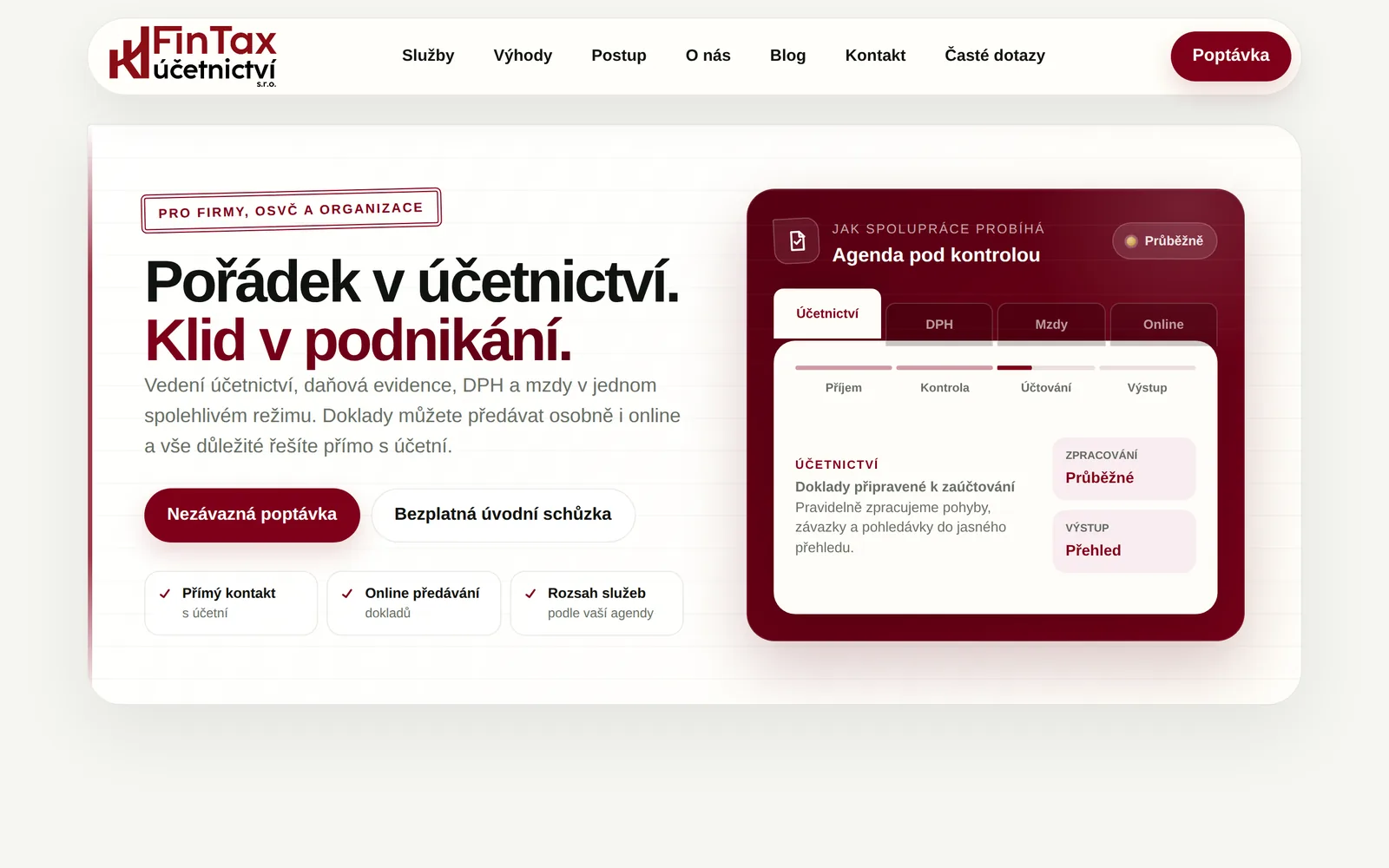
The kkfintax.cz homepage showing accounting services and an enquiry option
kkfintax.cz after handover into live operation

Go · forms · technical SEO · operation

Website and online enquiry for KK-FinTax

Starting point
An accounting firm needed to present its services clearly and guide prospective clients to a specific enquiry or meeting.
Delivered scope
A responsive website in Go with an enquiry and meeting booking, form validation and protection, technical SEO, consent management and container deployment.
Result
A website that connects presenting the services, qualifying enquiries and arranging the next step.
My role
Development of the website and the enquiry journey, automated tests and deployment into live operation.

Price and the first step

I confirm the price of the first version before work starts. It depends on the roles, data, integrations, data migration and availability requirements.

  1. Initial assessment free of charge

    We go through the situation and I tell you whether a custom solution makes sense and in which direction. It is not a detailed specification or a finished design.

  2. Defining the first version

    With a clear brief, it is enough to refine the scope. With an unclear one, we start with a paid analysis or a small prototype, the price of which I confirm in advance.

  3. Quote and delivery

    You receive the price and scope of the first version. Extensions and operation after launch are agreed separately.

Indicative prices from the price list

E-shop or web application
from CZK 90,000, priced individually by scope
Website management and monitoring
from CZK 400/month
Managed VPS or server
from CZK 590/month

The amount for an e-shop or web application is not a minimum for every integration. I price smaller integrations or changes to an existing system according to the defined scope. I am not registered for VAT.

What to prepare

The best starting point is not a long list of features, but one specific work scenario from input to result. Prepare a sample of your current spreadsheets or forms, user roles, decision rules, required outputs and the systems the data should be exchanged with. Mark any sensitive data and the change history you need to keep. An estimate of how often the process runs and how much time it takes today is also useful. Based on this information, the first usable version can be separated from features better suited to later stages.

How to prepare a brief for an application or integration
An off-the-shelf product, or custom development?

Before commissioning custom development, it is worth comparing configuring an existing service, simple automation and a full application. An off-the-shelf product is usually cheaper if it supports most of the process and does not require risky workarounds. Custom development makes more sense for unique know-how, specific integrations or repetitive work with measurable savings. The first version might, for example, cover one continuous flow, from receiving a form through checking the data to passing it into an internal record system; further roles and reports are added only once it has proved itself in practice. Before work starts, ownership of the source code, dependency licences, the repository location, access to infrastructure and the scope of documentation are agreed in writing, so that the handover does not depend on a vague verbal agreement. The price depends on roles, data, integrations, migration and availability requirements, which is why it is useful to start with a paid analysis or a small prototype.

An application you can run and keep developing.

The handover includes the source code, the production configuration and a description of the deployment, according to the agreed scope. The aim is a solution with no hidden manual steps and no dependence on a single undocumented environment.

  • A clearly described purpose, users and scope of the first version
  • Validated inputs and handled error states
  • Testable code and traceable configuration
  • Documented deployment, monitoring and backups

Ownership of the source code, the licence, where the repository is hosted and access to the infrastructure are agreed in writing before work starts. I can take over further operation and development myself, or someone else can continue from the documentation.

Typical parts of custom development

Not every project needs every layer. The architecture is chosen according to the data, integrations, number of users and how the application will be run.

  1. Analysis and design

    A description of the process, data, integrations and error states. A design for the first usable version that can be tested with real users.

  2. Implementation and testing

    Back-end and user interface development, input validation, automated tests and documentation of key decisions.

  3. DevOps and operations

    Containerisation, Ansible, CI/CD, reverse proxy, TLS, database, logging, monitoring and backups as part of the application, not as an add-on after launch.

  • Internal web applications
  • Enquiry and booking forms
  • Integration of external services and APIs
  • Automation of repetitive tasks
  • Database applications and admin interfaces
  • DevOps automation, CI/CD and operational monitoring

Frequently asked questions - Software development

What does custom software development include?

Custom software development starts with a description of the business process, users, data and integrations. This is followed by the design of the first usable version, implementation, testing, secure deployment and, as agreed, monitoring, backups and further development.

How does custom software development start?

First we describe the workflow, users, inputs, permissions, integrations and expected output. From that comes the scope of a first usable version that can be tested with real users.

Can you connect an application to external services and APIs?

Yes. Custom development can include integrating external services and APIs, data validation, handling of error states and monitoring whether the data exchange works.

Does development also include deployment and operation?

Yes, depending on the agreed scope. I can deliver containerisation, CI/CD, a reverse proxy, TLS, a database, logging, monitoring, backups and deployment documentation together with the application.

Not sure where to start? Describe the situation.

A few sentences about what is not working or what you need are enough. I will reply with a suggested first step and an estimate of the scope.

Let’s talk

Prices of the core services are listed in the indicative pricing.